
Dr Cat Dunn
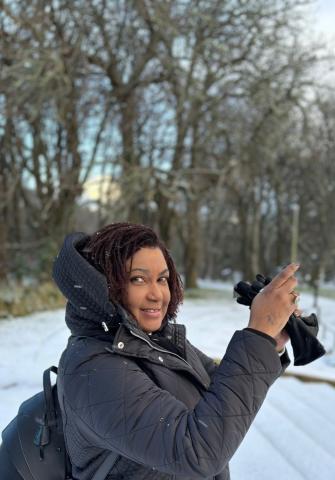
Dr Cat Dunn is a Barbadian-born, Scotland-based curator, researcher and educator whose practice explores the intersections of colonial histories, cultural identity, diaspora, memory and institutional power. Working across contemporary art, heritage and education, her research and curatorial projects challenge dominant historical narratives while creating space for marginalised voices, alternative knowledge systems and new ways of understanding belonging.
She holds a PhD from Duncan of Jordanstone College of Art & Design, University of Dundee, where her doctoral research, An Exploration of Re-Indigenisation as a Curatorial Method: Community, Resistance and Diaspora, developed a critical framework for reconsidering the relationships between curatorial practice, community agency, cultural memory and the enduring legacies of colonialism.
Central to Dunn's practice is the concept of re-indigenisation as a curatorial methodology: an approach that moves beyond simply inserting underrepresented histories into established institutional narratives. Instead, her work questions who constructs those narratives, whose knowledge is legitimised, and how curatorial practice can redistribute authority, centre lived experience and create meaningful opportunities for cultural self-representation.
Her curatorial projects include Crafted Selves: The Unfinished Conversation (2024–2025), Archaeology and Empire (2026), and White Ground, Black Water (2026–2027). Through collaborations with contemporary artists, cultural institutions and communities, these exhibitions examine the relationships between colonialism, identity, resistance, migration and the ongoing production of cultural memory.
Dunn is currently Project Curator (Histories and Legacies) at the University of Edinburgh, where her work engages with the University's colonial histories and their contemporary implications. Her approach combines archival research, contemporary artistic practice, student engagement and community collaboration to explore how institutional spaces and collections might be reinterpreted to foster greater visibility, representation and belonging.
Alongside her curatorial practice, Dunn has taught at the Glasgow School of Art and Duncan of Jordanstone College of Art & Design, contributing to critical discussions around decolonising methodologies, contemporary art, curatorial ethics and the politics of representation.
Grounded in her Caribbean heritage and experience of living and working in Scotland, Dunn's practice positions curating not simply as an act of displaying objects or interpreting histories, but as a form of critical inquiry, cultural resistance and collective reimagining. Her work asks how institutions might move beyond acknowledging difficult histories towards actively transforming the structures, relationships and narratives through which those histories continue to shape the present.